Install With Confidence.
Free, practical training for installers and electricians—plus the core guides you’ll use on-site: installation steps, user basics, and troubleshooting when something doesn’t behave as expected.
You can find the Elon Smart Installation Training Online Course here:
You can find the Elon Smart Installation Training Online Course here:

FOR INSTALLERS
A System You’ll Back
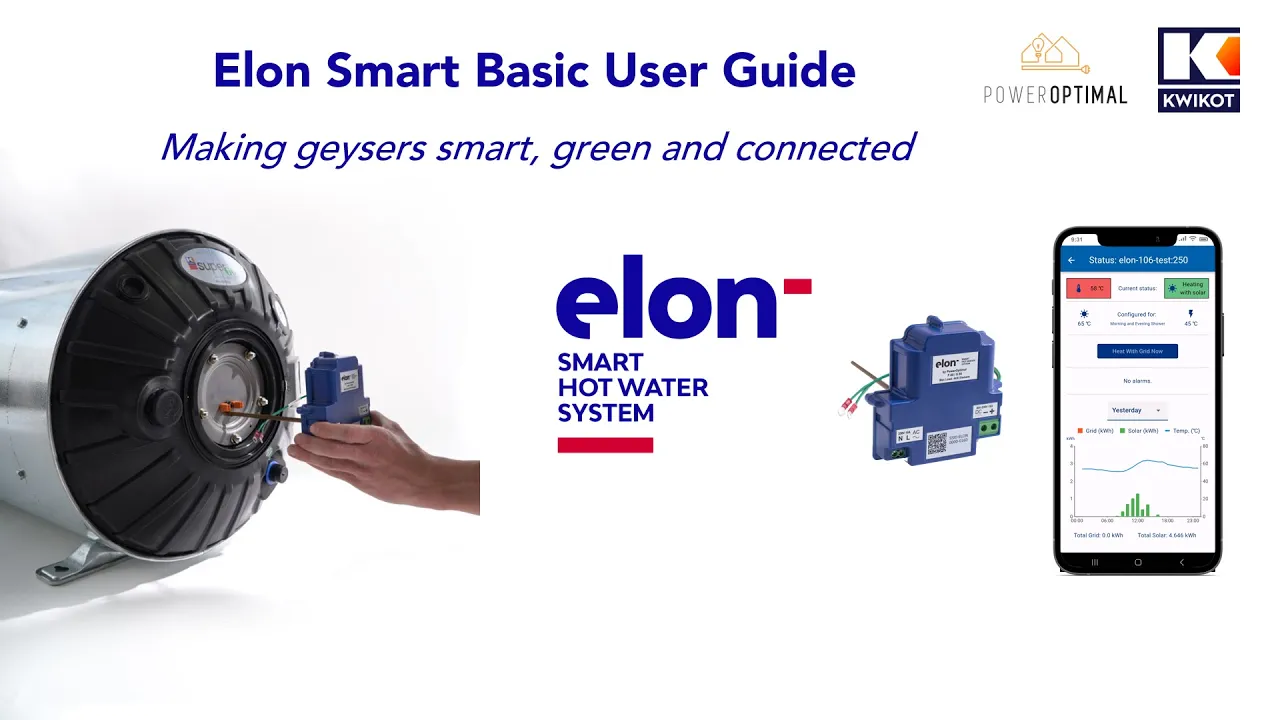
Basic User Guide
Troubleshooting Guide for Installers/Electricians
FOR INSTALLERS
A System You’ll Back
Basic User Guide
Troubleshooting Guide for Installers/Electricians
FAQs
Got questions?
We’re here to make Elon Smart easy to understand. Find answers to the most common questions below.
Still got questions?


Product & Technology
Costs & Compliance
Installation & Warranty
What makes Elon Smart Water different?

It’s the only solution that retrofits standard electric geysers and is solar PV-ready—combining smart thermostat control, connected monitoring and seamless solar integration.
Can the system be retrofitted to my existing geyser?
Yes — if you have a compatible geyser (for example from your preferred brand), your electrician can replace the thermostat with the Elon smart unit and convert it into a smart, solar-ready heater.
What is the difference between the Elon 100 and the Elon Smart Water solution?
The Elon 100 is a solar-PV water-heater kit. The Smart Water solution is a next-generation smart thermostat with solar-PV capability. Both allow you to connect solar PV modules to your standard electric geyser, but the Elon Smart has additional benefits and capabilities, including being able to see the water temperature, monitor and control your geyser from a smartphone.
How many solar panels or what size solar array do I need?
The size depends on your hot-water usage, location and array size; as a guide we recommend a minimum of around 1 kWp of solar PV for the retrofit system.
How do loadshedding and grid outages affect my system?
If there is sun the system can heat with solar; if there’s no grid and no solar it will pause heating. During load-shedding you still benefit whenever solar is available.
FAQs
Got questions?
We’re here to make Elon Smart easy to understand. Find answers to the most common questions below.
Product & Technology
Costs & Compliance
Installation & Warranty
What makes Elon Smart Water different?

It’s the only solution that retrofits standard electric geysers and is solar PV-ready—combining smart thermostat control, connected monitoring and seamless solar integration.
Can the system be retrofitted to my existing geyser?
Yes — if you have a compatible geyser (for example from your preferred brand), your electrician can replace the thermostat with the Elon smart unit and convert it into a smart, solar-ready heater.
What is the difference between the Elon 100 and the Elon Smart Water solution?
The Elon 100 is a solar-PV water-heater kit. The Smart Water solution is a next-generation smart thermostat with solar-PV capability. Both allow you to connect solar PV modules to your standard electric geyser, but the Elon Smart has additional benefits and capabilities, including being able to see the water temperature, monitor and control your geyser from a smartphone.
How many solar panels or what size solar array do I need?
The size depends on your hot-water usage, location and array size; as a guide we recommend a minimum of around 1 kWp of solar PV for the retrofit system.
How do loadshedding and grid outages affect my system?
If there is sun the system can heat with solar; if there’s no grid and no solar it will pause heating. During load-shedding you still benefit whenever solar is available.
FAQs
Got questions?
We’re here to make Elon Smart easy to understand. Find answers to the most common questions below.
Product & Technology
Costs & Compliance
Installation & Warranty
What makes Elon Smart Water different?
It’s the only solution that retrofits standard electric geysers and is solar PV-ready—combining smart thermostat control, connected monitoring and seamless solar integration.
Can the system be retrofitted to my existing geyser?
Yes — if you have a compatible geyser (for example from your preferred brand), your electrician can replace the thermostat with the Elon smart unit and convert it into a smart, solar-ready heater.
What is the difference between the Elon 100 and the Elon Smart Water solution?
The Elon 100 is a solar-PV water-heater kit. The Smart Water solution is a next-generation smart thermostat with solar-PV capability. Both allow you to connect solar PV modules to your standard electric geyser, but the Elon Smart has additional benefits and capabilities, including being able to see the water temperature, monitor and control your geyser from a smartphone.
How many solar panels or what size solar array do I need?
The size depends on your hot-water usage, location and array size; as a guide we recommend a minimum of around 1 kWp of solar PV for the retrofit system.
How do loadshedding and grid outages affect my system?
If there is sun the system can heat with solar; if there’s no grid and no solar it will pause heating. During load-shedding you still benefit whenever solar is available.
Still got questions?